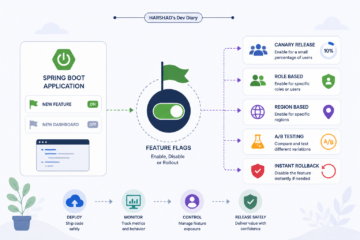
How to Use Feature Flags in Spring Boot for Safe Releases

Modern software delivery requires teams to deploy faster while minimizing production risk. Traditional release strategies often couple deployment and feature release together, which creates significant operational challenges. A single faulty deployment can impact all users immediately, forcing emergency rollbacks and causing downtime. Feature flags solve this problem by allowing teams Read more
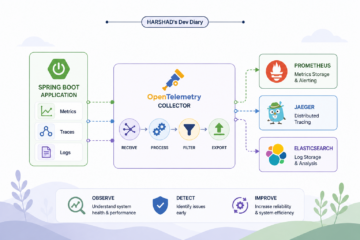
Spring Boot Observability: Metrics, Traces & Logs with OpenTelemetry Collector

Modern distributed systems are becoming increasingly complex. Microservices communicate across networks, asynchronous event-driven workflows span multiple services, and cloud-native environments scale dynamically. In such architectures, traditional debugging methods like checking application logs manually are no longer sufficient. This is where observability becomes essential. Observability helps engineering teams understand the internal Read more

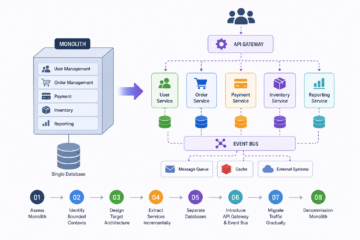
Migrating Monoliths to Microservices: A Step-by-Step Migration Blueprint

Many enterprise applications started as monoliths because monolithic architecture is simple to build, deploy, and manage during the early stages of product development. Over time, however, as teams grow and systems become more complex, monoliths often evolve into tightly coupled applications that are difficult to scale, maintain, and deploy efficiently. Read more

Secrets Rotation Strategies in Spring Boot with AWS/GCP/Azure

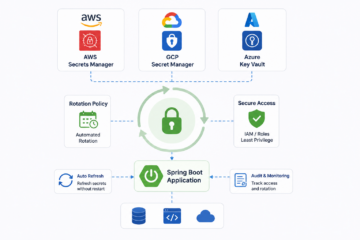
Managing secrets securely is one of the most critical responsibilities in modern cloud-native applications. API keys, database passwords, OAuth tokens, encryption keys, and certificates are frequently used across distributed systems, and exposing even a single credential can lead to severe security incidents. Many organizations still rely on static credentials stored Read more

Building Multi-Region Spring Boot Systems for Global Availability

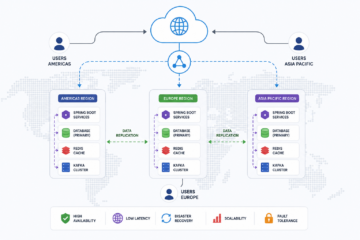
Modern applications are expected to remain available regardless of regional outages, traffic spikes, or infrastructure failures. Users accessing applications from different parts of the world also expect low latency and consistent performance. Traditional single-region deployments often struggle to meet these expectations because they introduce a single point of failure and Read more

Infrastructure as Code with Terraform: A Practical Guide for Java Developers

Monitoring Java Applications with Prometheus and Grafana on Kubernetes

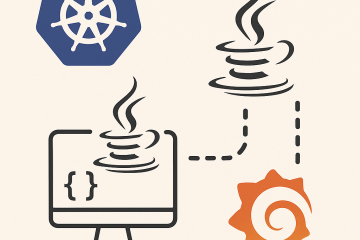
Introduction Modern microservices-based architectures rely heavily on observability to ensure applications perform reliably at scale.For Java applications running on Kubernetes, Prometheus and Grafana are the standard tools for monitoring and visualization. Together, they offer a flexible system for collecting, storing, and analyzing metrics — allowing developers to detect issues before Read more

Zero Downtime Deployments in Microservices: Blue/Green and Canary Strategies

Zero Downtime Deployments in Microservices: Blue/Green and Canary Strategies

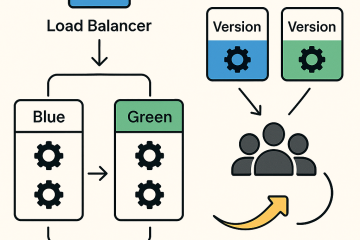
Introduction In today’s fast‑moving digital world, microservices architectures demand frequent updates without interrupting service availability. Zero downtime deployments are essential for mission‑critical systems—such as banking, e‑commerce, and high‑traffic consumer apps—to ensure customer trust and operational resilience. This article explores two established strategies—Blue/Green and Canary deployments—along with technical considerations, pipeline integration, Read more

CI/CD Pipeline for Java Applications with Jenkins & AWS CodePipeline

Building a CI/CD Pipeline for Java Applications with Jenkins and AWS CodePipeline

Building a CI/CD Pipeline for Java Applications with Jenkins and AWS CodePipeline Continuous Integration and Continuous Deployment (CI/CD) are essential for delivering software reliably and rapidly. In this guide, we’ll build a professional CI/CD pipeline for a Java application using Jenkins and AWS CodePipeline. By combining Jenkins’s flexibility with AWS CodePipeline’s managed delivery Read more