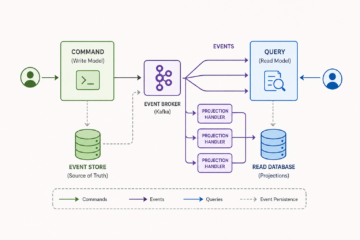
Implementing CQRS and Event Sourcing in Spring Boot

Modern enterprise applications often struggle with scalability, complex business workflows, and maintaining consistency across distributed systems. Traditional CRUD-based architectures become difficult to manage as applications evolve and business rules become more sophisticated. This is where CQRS (Command Query Responsibility Segregation) and Event Sourcing emerge as powerful architectural patterns. In this Read more

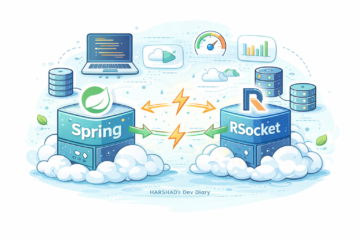
Building Reactive Microservices with Spring WebFlux & RSocket

Modern microservices architectures are evolving rapidly to meet the demands of high concurrency, real-time data processing, and efficient resource utilization. Traditional blocking models, while simple, often struggle under heavy load due to thread limitations and I/O bottlenecks. Reactive programming offers a compelling alternative. By combining non-blocking execution with event-driven communication, Read more

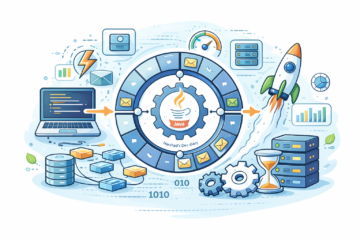
Designing High-Throughput Event-Driven Systems Using Java & Disruptor Pattern

In today’s world of real-time systems, traditional architectures often fail to meet the demands of ultra-low latency and high throughput. Whether you’re building trading platforms, telemetry pipelines, or high-scale APIs, the ability to process millions of events per second is no longer optional. This is where the Disruptor pattern, popularized Read more

How to Tune JVM for Low-Latency Applications

Modern applications—from real-time trading systems to high-frequency APIs—demand consistent low latency. While Java provides excellent performance, improper JVM tuning can introduce GC pauses, memory bottlenecks, and unpredictable latency spikes. This guide dives deep into practical JVM tuning strategies to help you achieve predictable, low-latency performance. Understanding Latency in JVM Applications Read more

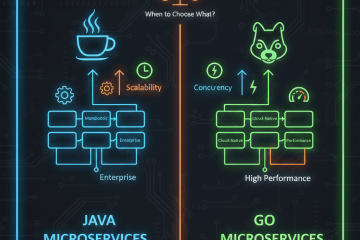
Java Microservices vs Go Microservices: When to Choose What?

Java Microservices vs Go Microservices: When to Choose What?

Microservices have become the backbone of modern distributed systems. As organizations decompose monolithic applications into independently deployable services, the choice of programming language plays a critical role in performance, scalability, developer productivity, and long-term maintainability. Two languages frequently compared in this space are Java and Go (Golang). Both are production-proven, Read more

Building Real-Time Applications in Java: Architecture & Framework Choices

Building Real-Time Applications in Java: Architecture & Framework Choices

Real-time applications have moved far beyond chat systems and stock tickers. Today, they power financial trading platforms, collaborative tools, live dashboards, multiplayer games, IoT monitoring systems, and streaming analytics pipelines. For Java developers, building real-time systems presents a unique challenge: how do you deliver low latency, high throughput, and predictable Read more

A Deep Dive into Java’s Garbage Collection Algorithms (ZGC, Shenandoah, G1GC)

A Deep Dive into Java’s Garbage Collection Algorithms (ZGC, Shenandoah, G1GC)

Memory management has always been one of Java’s strongest advantages—and one of its most misunderstood components. While Java developers rarely manage memory manually, the choice and tuning of the Garbage Collector (GC) can dramatically impact application latency, throughput, and scalability. With modern JVMs offering multiple advanced collectors, understanding G1GC, ZGC, Read more

Mastering Asynchronous Programming in Java with CompletableFuture

Mastering Asynchronous Programming in Java with CompletableFuture

Modern applications are expected to be fast, responsive, and capable of handling multiple operations concurrently. In Java, traditional multithreading using Thread, Runnable, and ExecutorService often leads to verbose code, complex error handling, and difficult-to-maintain logic. This is where CompletableFuture, introduced in Java 8, fundamentally changes how we write asynchronous and Read more

How to Build High-Performance APIs in Java Using gRPC

How to Build High-Performance APIs in Java Using gRPC

Introduction As modern systems scale, traditional REST-based APIs often begin to show limitations—especially in latency-sensitive and high-throughput environments. JSON serialization overhead, verbose payloads, and HTTP/1.1 constraints can become bottlenecks in distributed systems. This is where gRPC stands out. gRPC is a high-performance, open-source RPC framework that uses HTTP/2 and Protocol Read more

JVM Internals Explained: Class Loaders, Bytecode, and Execution Engine

JVM Internals Explained: Class Loaders, Bytecode, and Execution Engine

Introduction One of Java’s greatest strengths is its promise of “write once, run anywhere.” Behind this promise lies the Java Virtual Machine (JVM)—a sophisticated runtime that abstracts hardware, manages memory, executes bytecode, and optimizes performance dynamically. Many Java developers use the JVM every day, yet only a few truly understand Read more