Modern applications are expected to remain available regardless of regional outages, traffic spikes, or infrastructure failures. Users accessing applications from different parts of the world also expect low latency and consistent performance. Traditional single-region deployments often struggle to meet these expectations because they introduce a single point of failure and higher response times for geographically distant users.
This is where multi-region architecture becomes critical.
By deploying Spring Boot applications across multiple geographic regions, organizations can achieve high availability, disaster recovery, fault tolerance, and improved user experience globally.
In this blog, we will explore how to build multi-region Spring Boot systems, discuss architecture strategies, data replication approaches, traffic routing, failover handling, distributed caching, observability, and production-grade deployment best practices.
Understanding Multi-Region Architecture
A multi-region system runs application services in multiple geographic locations simultaneously.
Example regions:
- Mumbai
- Singapore
- Frankfurt
- Virginia
- Sydney
Each region contains:
- Application instances
- Databases
- Cache layers
- Load balancers
- Monitoring infrastructure
Traffic is routed dynamically to the nearest or healthiest region.
Why Multi-Region Systems Matter
Single-region systems create several risks:
Regional Cloud Outages
Entire cloud regions can fail unexpectedly.
Increased Latency
Users far from the hosting region experience slower response times.
Disaster Recovery Challenges
Recovery from catastrophic failures becomes slower.
Scalability Bottlenecks
One region may struggle during traffic surges.
Multi-region deployments address these problems by distributing workloads globally.
Key Benefits of Multi-Region Systems
High Availability
Applications remain accessible even if one region fails.
Lower Latency
Users connect to geographically closer regions.
Better Fault Tolerance
Traffic reroutes automatically during outages.
Improved Disaster Recovery
Failover recovery becomes faster and more automated.
Regulatory Compliance
Certain countries require local data residency.
Multi-Region Deployment Models
There are several architectural approaches.
Active-Passive Architecture
In active-passive:
- One region handles traffic
- Secondary regions remain on standby
- Failover occurs during outages
Advantages
- Simpler implementation
- Lower operational complexity
- Easier consistency management
Disadvantages
- Secondary infrastructure remains underutilized
- Failover may take time
Active-Active Architecture
In active-active:
- Multiple regions serve traffic simultaneously
- Traffic distribution occurs globally
- Data replication happens continuously
Advantages
- Maximum availability
- Better scalability
- Lower latency worldwide
Disadvantages
- Complex distributed consistency
- Conflict resolution challenges
- Higher operational cost
Recommended Architecture for Spring Boot
A production-grade multi-region architecture typically includes:
- Global DNS routing
- Regional load balancers
- Spring Boot application clusters
- Distributed databases
- Multi-region caching
- Event streaming systems
- Observability stack
Technology Stack
For this implementation, we will use:
- Java 21
- Spring Boot
- Kubernetes
- PostgreSQL
- Redis
- Apache Kafka
- Docker
- Terraform
- Prometheus
- Grafana
Designing Stateless Spring Boot Services
Stateless services are essential for multi-region deployments.
Avoid storing:
- User sessions in memory
- Temporary state locally
- Region-specific assumptions
Instead:
- Use JWT authentication
- Externalize session storage
- Store files in object storage
- Use distributed caches
Configuring Spring Boot for Multi-Region
Application Configuration
server:
  port: 8080

app:
  region: ap-south-1

management:
  endpoints:
    web:
      exposure:
        include: health,info,prometheus
The region identifier helps in monitoring and request tracing.
Health Check Endpoints
Health endpoints are critical for global load balancing.
Spring Boot Actuator
<dependency>
    <groupId>org.springframework.boot</groupId>
    <artifactId>spring-boot-starter-actuator</artifactId>
</dependency>
Health endpoint:
/actuator/healthLoad balancers use this endpoint to determine regional availability.
Global Traffic Routing
Traffic routing determines which region receives requests.
Common strategies include:
Geo-Based Routing
Users connect to the nearest region.
Latency-Based Routing
Traffic goes to the region with the fastest response time.
Weighted Routing
Traffic distribution percentages are controlled manually.
Failover Routing
Backup regions activate during outages.
DNS-Based Routing
Cloud providers commonly use DNS routing services.
Examples:
- Amazon Route 53
- Cloudflare
- Google Cloud DNS
Example Route 53 policy:
India users -> Mumbai region
Europe users -> Frankfurt region
US users -> Virginia region
Multi-Region Database Strategies
Databases are often the hardest part of multi-region systems.
Single Primary Database
One region acts as primary.
Other regions use read replicas.
Advantages
- Easier consistency
- Simpler transactions
Disadvantages
- Write latency across regions
- Primary region dependency
Multi-Primary Database
Multiple regions accept writes simultaneously.
Examples:
- CockroachDB
- Google Cloud Spanner
- Amazon DynamoDB Global Tables
Advantages
- Low-latency writes globally
- Better availability
Disadvantages
- Conflict resolution complexity
- Eventual consistency trade-offs
PostgreSQL Read Replica Example
Spring Boot datasource configuration:
spring:
  datasource:
    url: jdbc:postgresql://primary-db:5432/app
    username: appuser
    password: secret
Read-only replicas can serve query-heavy workloads.
Distributed Caching
Caching reduces latency significantly.
Use:
- Redis Cluster
- Regional caches
- Cache invalidation events
Redis Multi-Region Considerations
Challenges include:
- Replication lag
- Cache inconsistency
- Network partitions
Recommended approach:
- Use regional caches
- Replicate only critical data
- Use TTL aggressively
Event-Driven Replication with Kafka
Distributed systems often synchronize asynchronously using events.
Example architecture:
Region A -> Kafka -> Region BUse cases:
- User updates
- Inventory synchronization
- Audit events
- Payment status updates
Kafka Replication
For global deployments:
- Use MirrorMaker 2
- Configure regional clusters
- Enable topic replication
Benefits:
- Event durability
- Cross-region synchronization
- Reduced coupling
Kubernetes Multi-Region Deployment
Regional Kubernetes Clusters
Deploy separate clusters per region.
Example:
Mumbai Cluster
Singapore Cluster
Frankfurt Cluster
Kubernetes Deployment Example
apiVersion: apps/v1
kind: Deployment

metadata:
  name: springboot-app

spec:
  replicas: 4

  selector:
    matchLabels:
      app: springboot-app

  template:
    metadata:
      labels:
        app: springboot-app

    spec:
      containers:
        - name: app
          image: company/app:1.0
Managing Configuration Across Regions
Use centralized configuration systems:
- Spring Cloud Config
- HashiCorp Vault
- Kubernetes Secrets
- AWS Parameter Store
Avoid hardcoded regional values.
Distributed Tracing
Tracing becomes essential in globally distributed systems.
Recommended tools:
- Jaeger
- Zipkin
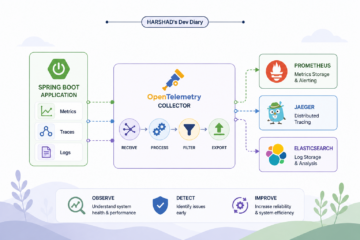
- OpenTelemetry
Metrics and Monitoring
Important metrics include:
- Regional latency
- Error rates
- Replication lag
- Failover duration
- Kafka consumer lag
- Database response time
Recommended stack:
- Prometheus
- Grafana
Handling Failover
Failover must be automatic.
Key requirements:
- Fast health detection
- Automated DNS switching
- Stateless applications
- Data replication readiness
Example failover flow:
Mumbai outage detected
↓
DNS redirects traffic
↓
Singapore becomes primary
Session Management
Avoid sticky sessions whenever possible.
Recommended approaches:
- JWT tokens
- OAuth2 stateless authentication
- Shared Redis session store
Managing File Storage
Do not store files locally inside containers.
Use:
- Amazon S3
- Google Cloud Storage
- Azure Blob Storage
These services replicate globally automatically.
Security Considerations
Multi-region systems increase security complexity.
Important areas:
Inter-Region Encryption
Encrypt traffic between regions.
Identity Federation
Use centralized identity providers.
Secret Management
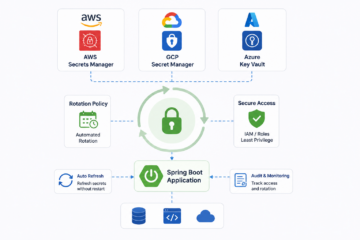
Use secure vault systems.
Regional Compliance
Comply with local regulations like GDPR.
Common Challenges
Data Consistency
Global replication introduces eventual consistency challenges.
Operational Complexity
Managing many regions requires mature DevOps practices.
Increased Infrastructure Costs
Global deployments increase operational expenses.
Cross-Region Latency
Replication traffic can become expensive and slower.
Best Practices
Keep Services Stateless
Stateless systems scale and failover more easily.
Use Regional Isolation
Avoid cascading failures across regions.
Automate Infrastructure
Use Infrastructure as Code tools like Terraform.
Test Disaster Recovery Regularly
Simulate regional outages frequently.
Monitor Everything
Observability is mandatory for distributed systems.
When Should You Build Multi-Region Systems?
Multi-region architecture is ideal when:
- Applications require 99.99% uptime
- Users are globally distributed
- Disaster recovery is critical
- Regulatory compliance requires regional hosting
- Applications handle large traffic volumes
Avoid multi-region deployments for:
- Small internal tools
- Low-traffic systems
- Simple monoliths
- Early-stage prototypes
Final Thoughts
Building multi-region Spring Boot systems requires careful architectural planning, distributed systems knowledge, and strong operational maturity. While the complexity increases significantly compared to single-region deployments, the benefits of global availability, low latency, and disaster resilience are substantial for enterprise-scale applications.
Using Spring Boot alongside technologies like Kubernetes, Apache Kafka, and distributed databases enables organizations to build globally resilient systems capable of handling modern scalability demands.
The key is to start with clear business requirements, design for failure from day one, and gradually evolve the platform toward global resilience rather than over-engineering too early.

0 Comments